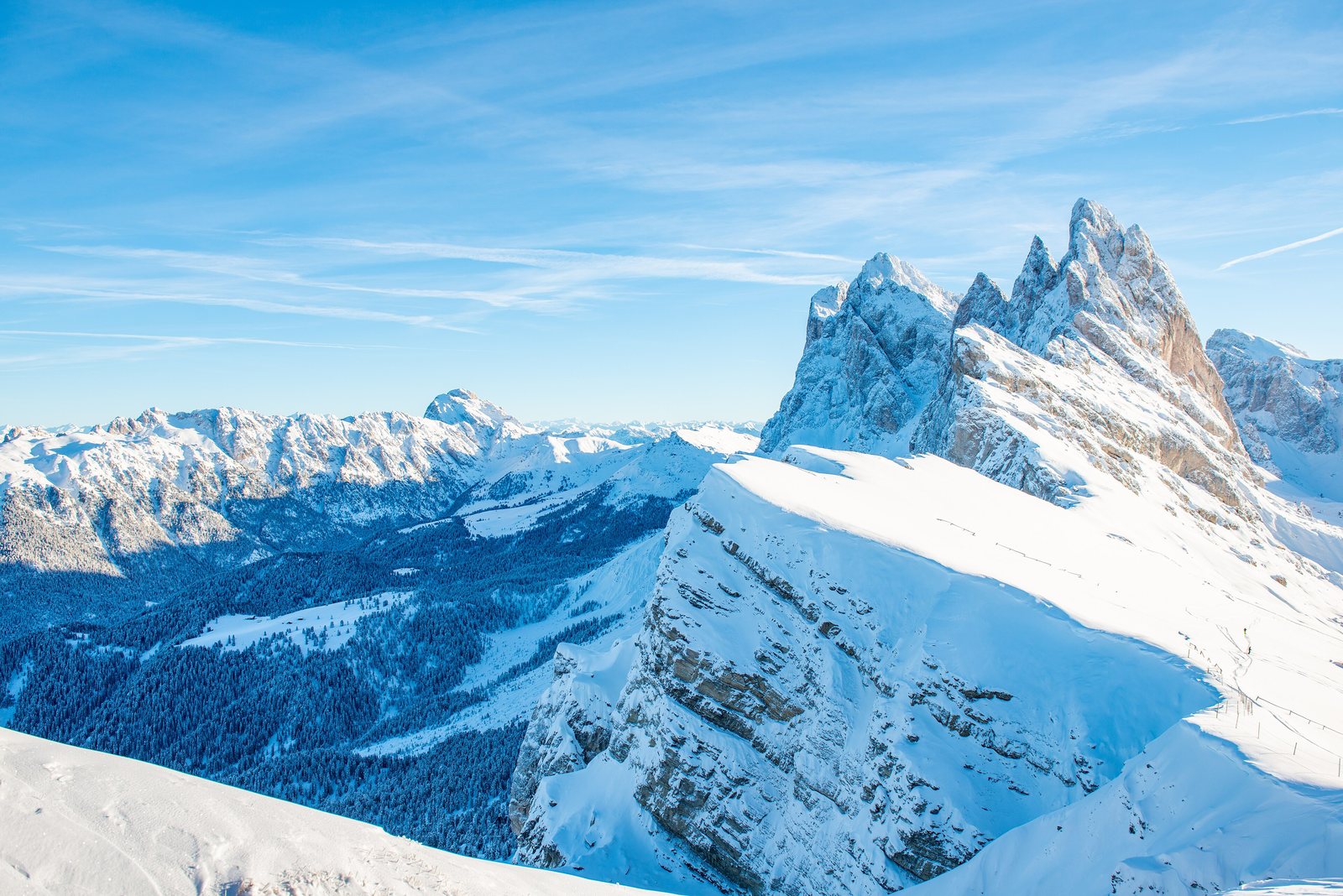
Ortisei / St. Ulrich

4.5

The biggest town in Val Gardena, between Seceda and the Alpe di Siusi, with no ski-in at all.

Stayed here
The Seceda ridge above Ortisei in winter1,236 m
–
–
–

Forecast at 1800 m today: low / high, modelled snow depth, and new snow in the last 24 hours.

Terrain4.5
Snow4.5
Lifts4.5
Village3.0
Mountain food5.0
Après4.5
Families5.0
Value4.0
Best for
Experts
Intermediates
Families
Beginners

Is Ortisei a good base for skiing?

It depends on what you want from the evenings. Ortisei (St. Ulrich) is by far the biggest village in the valley, with lots of restaurants and hotels, a big spa, and nightlife on par with Selva. In winter there's a frozen fountain in the river, which looks amazing. If you'd rather not feel stuck in a small village in the middle of nowhere, this is the place.

The catch is that there's no ski-in at all. Wherever you stay, you walk to the lifts carrying your skis, and crossing town between the two ski areas takes about 20 minutes on foot. In return you sit between both: Seceda and the Sella Ronda on one side, the Alpe di Siusi on the other, and you can ski to the far edges of both. Prices are mid-to-high for the region.

The skiing

La Longia, from the top of Seceda down to Ortisei, is one of the most spectacular ski slopes we've ever skied: 10.5 km and almost 1,300 m of drop, red then blue, through open pastures and then forest and rock. Make it the last run of the day. On the other side of town, the Alpe di Siusi is mostly easy blues, with a short, very steep black near Compatsch for your top speed.

Day routes

Ski from Ortisei

5 day routes from here, with how to start each one from Ortisei.

Sella Ronda orange (clockwise)

Full dayRed runsIntermediate and up
  • Dantercepies gondola
  • Passo Gardena
  • Colfosco and Corvara
  • Passo Campolongo
  • Arabba
  • Passo Pordoi
  • Down to Plan Frataces
  • Passo Sella
  • Back to Val Gardena

From here: Walk to the Furnes gondola, take the Seceda cable car, ski past Col Raiser and ride the underground funicular to the Saslong, then up to Ciampinoi. Home the same way, finishing on La Longia.

The circuit around the Sella group, clockwise. It's our preferred direction: a bit steeper and faster than the green, though the difference isn't big. The long, wide red from the Pordoi side down to Plan Frataces, near Canazei, is one of the best runs of the day.

Start before 10:00 and cross the last pass before 15:30. That's the official advice, and missing a link means a long taxi ride home.

Sella Ronda green (anticlockwise)

Full dayRed runsIntermediate and up
  • Ciampinoi
  • Plan de Gralba
  • Passo Sella
  • Down to Plan Frataces
  • Passo Pordoi
  • Arabba
  • Passo Campolongo
  • Corvara and Colfosco
  • Passo Gardena
  • Back to Selva

From here: Same start and finish as the orange: Seceda, Col Raiser, the funicular and Ciampinoi, home on La Longia.

The same circuit the other way round, through the Città dei Sassi boulder field under the Sassolungo. The red down from Passo Sella to Plan Frataces is long, wide and scenic, with an amazing vibe.

Same timing as the orange: start before 10:00 and cross the last pass before 15:30.

Marmolada and Punta Rocca

Longest dayBlack runsGood skiers who keep the pace
  • Sella Ronda to Arabba
  • Lifts to Passo Padon
  • Down to Malga Ciapela
  • Marmolada cable car, 3 sections
  • Punta Rocca 3,265 m
  • La Bellunese
  • Back to Arabba
  • Finish the Sella Ronda

From here: Seceda, the funicular and Ciampinoi, then either Sella Ronda direction to Arabba. Leave town by 9:00, and get back up to Seceda for La Longia.

The big one. Ride either Sella Ronda direction to Arabba, cross to Malga Ciapela and take the three-section cable car up the Marmolada, with restaurants and souvenir shops on the way. From the observation deck at Punta Rocca you see the Marmolada glacier and the whole Sella group in front of you, often with the clouds below. Then ski La Bellunese down, about 12 km, long, steep and bumpy, and finish the Sella Ronda you started. If you have time, the Porta Vescovo detour from Arabba adds a couple of nice reds through the forest.

The difficulty is pace. Leave by 9:00 (10:00 at the latest, and only if you're well prepared), have lunch in or near Arabba, ideally after the Marmolada, and leave Punta Rocca by 14:30 at the very latest, only if you're fast and skip lunch. It can be very windy at the top even on a clear day.

Alpe di Siusi, the far point

Shortest dayBlue runsAll levels
  • Cable car from Ortisei
  • Alpe di Siusi plateau
  • Compatsch
  • Puflatsch lift
  • The Puflatsch black
  • Back across the plateau

From here: The cable car up to the Alpe di Siusi leaves from town.

Across the valley from Seceda lies the Alpe di Siusi (Seiser Alm), Europe's largest high-alpine meadow. The runs are mostly basic blues, so beginners and intermediates will love it. Strong skiers should head for the far edge near Compatsch: the combined gondola-and-chair lift goes up to the Puflatsch (Bullaccia) plateau at about 2,100 m, where you ski along the top on a red and turn left onto a short black. It's very steep, streamlined and usually well groomed, a chance to just full send it and check your top speed in your app.

Alta Badia: Corvara to Santa Croce

Full dayBlue runsRelaxed, suits less experienced skiers
  • Corvara
  • Col Alt gondola
  • Piz La Ila
  • Red or black to La Villa
  • Through to Badia
  • La Crusc gondolas
  • Santa Croce 2,045 m
  • Same way back

From here: A long way from here: only on long days in midwinter.

A nice, easy day trip with lots of blues. From Corvara, take the Col Alt gondola and ski down into the valley where many pistes meet: a good place to just ski and explore. Cross to Piz La Ila and take the red or the black down to La Villa (both are good), ski through towards Badia, then two gondola sections take you up to Santa Croce, the furthest point, by its pilgrimage church. Ski the same way back.

From Val Gardena, Corvara is half a Sella Ronda away, so count the time to get back over Passo Gardena.

All Dolomiti Superski day routes

Getting there

Take the train from Milan to Bolzano (Bozen), usually changing at Verona; it's a very good link. From Bolzano, and from Chiusa or Bressanone, regional buses run up the valley, so you don't need a car or a private transfer. Bolzano and Bressanone (Brixen) are both sizeable Alpine towns and nice to walk around if you have an hour between trains.